🧮 Riemann Hypothesis — when AI and Lean change mathematical research
On November 20, 2026, mathematician Levent Alpöge announced a proof of the Riemann hypothesis, a problem formulated in 1859. To find it, he says he worked with Claude. To allow others to verify it, he published a library of proofs written in Lean. The next day, the Lean and Mathlib communities certified the statement and the formal proof of the classical hypothesis. Between these two dates, a question familiar to developers took on another dimension. How can we verify that a result produced with the help of a model answers the exact question posed? Alpöge's announcement · Lean and Mathlib statement

Why prime numbers lead to Riemann
A prime number is an integer greater than 1 that has exactly two positive divisors, 1 and itself. Thus, 2, 3, 5, 7 and 11 are prime. The number 12, however, factors as 2² × 3. Every integer greater than 1 decomposes uniquely into prime factors, up to order. Yet, when scanning integers, one sometimes encounters primes very close together, like 11 and 13, followed by longer gaps with no primes. How can we describe this irregularity?
Riemann approached the question by studying a function of the complex variable s.
ζ(s) = 1 + 1/2ˢ + 1/3ˢ + ⋯ for Re(s) > 1.
In this region, one can also write the same function in the form of the Euler product ∏ₚ (1 − p⁻ˢ)⁻¹, where p runs over the prime numbers. By expanding the factors, every integer appears thanks to its decomposition into prime factors. The analytic continuation then coherently extends the function to other complex values, with a pole at s = 1. This extension allows talking about zeros in a region where the initial series no longer converges. Clay Mathematics Institute statement · Quanta video, with Alex Kontorovich
A zero is a value of s for which ζ(s) = 0. The negative even integers −2, −4, −6, … constitute the so-called trivial zeros. The others lie in the band 0 < Re(s) < 1. The Riemann hypothesis asserts that they are all on the vertical line Re(s) = ½. Zeros appear in formulas that relate the zeta function to the counting of prime numbers. Their position thus allows bounding the difference between this count and an approximation, without providing the position of the next prime. Riemann Manuscript · Clay Mathematics Institute
What Alpöge says he found with Claude
In his four-page note, Alpöge describes analogies he chose and technical steps to which Claude contributed. An example he gives concerns the length of a chain of theta lifts. These constructions appear in an argument that combines Stepanov’s ideas and Fourier analysis with a weighted sum related to prime numbers. The note provides references on the method. The detail of the argument is in the Lean library, distributed in fourteen parts and counting about 17 million lines. Alpöge also mentions, in a note, an essay of more than 250,000 pages. This figure describes that essay, while the 17 million count the lines of the library. Mathematicians have since begun writing expositions about it, including a working guide devoted to the case of the zeta function. Alpöge note · Expositions and checks by Michael Rubinstein
What Lean has verified
Lean is a language and a proof assistant. A definition fixes the meaning of a mathematical object there, for example the zeta function. A theorem there is a precise statement, accompanied by its hypotheses. Mathlib collects definitions and reusable results. The kernel of Lean then checks that the proof term matches the statement according to the system’s rules. A language model can propose a lead or write code. The verifier checks the logical steps in a reproducible way.
The November 21 declaration explicitly states that “both the statement and the proof of the Riemann Hypothesis are correct.” The people responsible for the verification reproduced the compilation, isolated the reference statement in Mathlib and compared that statement with the one demonstrated by Alpöge’s library. Several kernels have checked the exported proof. Andrew Sutherland’s MIT report also documents an independent and precise reconstruction that the five main statements rest solely on three standard Lean axioms, including the classical axiom of choice. The robustness of these checks rests on both the relevance of the formal statement and on the logic, the axioms and the implementations of the verifiers. Lean and Mathlib declaration · MIT checks report
The public certification of Lean and Mathlib concerns the classical hypothesis (RH). The MIT report as of November 22 also documents positive checks for the generalized Riemann Hypothesis (GRH), in the case of Dirichlet L-functions. The extended hypothesis (ERH) mentioned in the announcement remains a prospect. Work on a human-readable explanation continues. Meanwhile, the Clay Mathematics Institute still lists “Unsolved” and follows a different procedure for the Millennium Prize. MIT checks · Clay status · Prize rules
What happens to conditional theorems?
On X, Elon Musk highlighted a logical consequence of the proof. Statements already proven under the assumption of the Riemann Hypothesis can rely on his proof to drop that condition. The same message attributes the result to the “super intelligence,” an interpretation of Musk. His second message repeats the first with an astonishment emoji. The scientific verification, meanwhile, is documented by the Lean and Mathlib communities and by independent reconstructions. First post by Musk · Following reaction
One example is the corollary published by Lowell Schoenfeld in 1976. Under RH, it bounds the difference between the number of primes π(x) up to x and the approximation li(x). For x ≥ 2657, the absolute value of this difference is strictly less than √x log(x) / (8π). Once RH is established, this consequence follows from the implication already proven. The threshold x ≥ 2657 and the conventions of the statement remain in effect. Consequences that assume a broader form of RH require checking this other hypothesis. Schoenfeld, original article
What this means for computing
One avenue is to get several tools to cooperate, each with a defined role. One agent can search for lemmas in a library, another propose a strategy or Lean code, and an independent kernel can verify the results. Discarded proposals and accepted proofs can keep a record of their hypotheses. The same principles illuminate symbolic computation, algorithm search, and educational tools that require the user to justify a step.
The distinction also matters in cryptography. Knowing the precision of a prime-counting function and finding the factors of a particular integer are two different problems. The verification of RH as documented here does not provide any new factorization algorithm that would break RSA. On Darkwood’s side, Flow could be used to orchestrate trials, record proposals, and call an independent verifier. This orchestration remains a line of work. Controlled statements · Darkwood Flow
If agents can propose increasingly more leads, how can we make their results verifiable, explainable and accessible to researchers as well as to people who discover mathematics?
Explore mathematics with Darkwood
Darkwaar · Prime Lanterns

Darkwaar
Prime Lanterns
Four grids invite players to identify prime numbers and multiples. Each choice comes with an explanation, and correct answers light the lanterns.
HeroClip · Les nombres invisibles
HeroClip
Les nombres invisibles
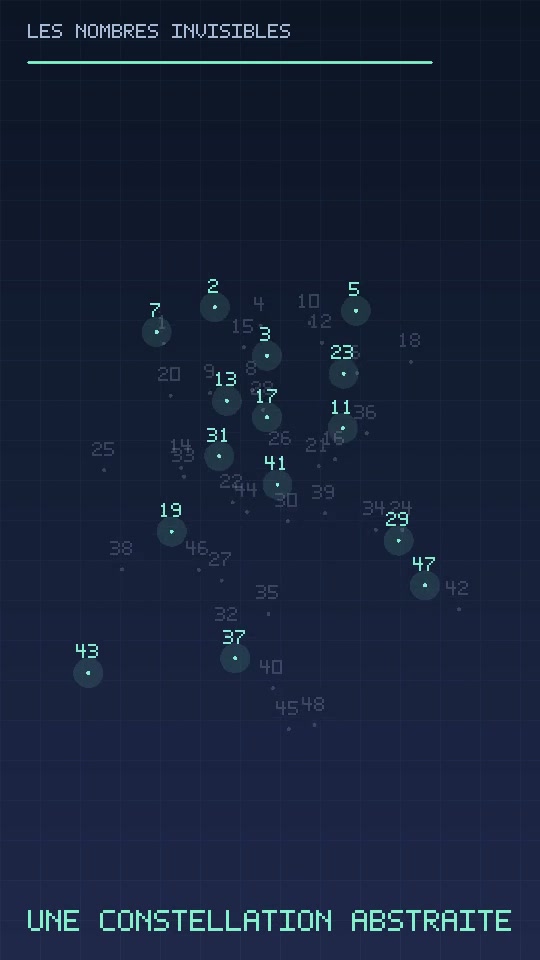
The integers 1 to 48 appear in a grid. The primes light up, then the dots form an abstract constellation set to an original soundtrack.
DJ Matyo · Prime Frequencies
DJ Matyo
Prime Frequencies
Two electronic pieces combine cycles of three, five and seven beats. The bass, melody and bell return in a different rhythmic combination each time.
Go further with Bonzai
The Automation avec Flow en PHP subscription, at €20/month, extends this reflection into practice. The page presents content around automation with Flow and AI, as well as a private Telegram channel for exchanges. Discover the offer, its content and terms on Bonzai

matyo91
💫 Créateur de Hacker News - Toyota, Nissan et Honda standardisent les pièces pour réduire les coûts

💫 GitHub Creator - php: php/frankenphp: v1.14.0

💫 YouTube Creator - Devscast Software: PHP 8.6 : les nouvelles fonctionnalités

🤖 Veille Darkwood - 2026-11-22

🎧 Sélection DJ Matyo - 2026-11-21

💫 Bluesky Creator - @martinfowler.com: Fragments Insights

💫 Créateur de Hacker News - Je n'achèterai plus jamais de matériel Framework

💫 GitHub Creator - widelands: Development Builds

🤖 Darkwood Update - Symfony AI, MCP et PHP 8.6

🤖 Veille Darkwood - 2026-11-21

📈 Veille Investissement Darkwood - 2026-11-20

🤖 Veille Darkwood - 2026-11-20

🎧 Sélection DJ Matyo - 2026-11-19

💫 Hacker News Creator - Exécution de code à distance non authentifiée dans Nginx

🤖 Veille Darkwood - 2026-11-19

💫 Bluesky Creator - @martinfowler.com: Comprendre les contrats de données

💫 Hacker News Creator - GPT‑6.2 Astra et Sol

🤖 Veille Darkwood - 2026-11-18

📈 Veille Investissement Darkwood - 2026-11-17

💫 arXiv Creator - stat.ML : apprentissage optimal par chaîne de pensée autorégressive via Bagging
